


How to Raise a Resilient Family Dog

I get asked this a lot…. “When should I start preparing my dog for a baby?” The answer is simple: the day you bring your puppy/dog home!

Hear me out. Life with a baby (and eventual child) is noisy, chaotic, busy, and unpredictable. It also entails many situations in which your dog needs to be physically separated from you and/or your baby/child. The best way to have a dog who can handle all of this is to raise your puppy with all of these things in a very thoughtful and intentional way.
The best part is that following these tips will help your puppy build resilience as a skill regardless of whether kids are in your future, and help prepare them for visiting kiddos, canines, and adults.
For simplicity, I will use the term puppy/pup and call the pup a “he,” but you can introduce these concepts to your current dog(s) and/or newly adopted adult dogs as well. NOTE: Dogs over 1 year old won't need as frequent visits/introductions to new people/dogs since they are past all of their sensitive periods, and you'll need to work with what they can handle and enjoy based on their adult temperament:
While potty training, vary the time you feed your puppy within a 20 minute window for each meal (e.g. any time from 6:30-6:50am for breakfast).
Once potty training is going well (no accidents for 4 weeks), feed your puppy within a 45 minute to 1 hour window (e.g. 6:30-7:15/7:30am).
Take your puppy to a new place 3 days a week. Start with friends’ & neighbors’ homes and backyards* while your puppy is finishing their vaccination series. This is both for health & safety, but also to keep the level of stimulation low while keeping the opportunity to safely explore high.
Once your puppy is fully vaccinated, take them somewhere new at least once a week. Nature trails are great for physical and mental stimulation, and cafes are an excellent place to practice your pup’s settle (bring a good chew!). Again, do be careful that your puppy is not overstimulated or stressed - they should not be leaping, lunging, or barking, though some pulling on leash and the occasional whine may be expected at first.
Allow your pup to explore and play outdoors* at their own pace as often as possible, both with and without other dogs**. Living a primarily indoor life prevents them from exploring and navigating challenges needed to build confidence in the “real world.” Free play outdoors is like a vaccination against anxiety later in life (in both dogs and humans!).

Find people of varying ages and backgrounds for your pup to meet and interact with, ideally in a home where the people can be sitting down and the pup can approach at their own pace to start. In addition to visiting neighbors, inviting your neighbors over one family at a time is a great way to get to know the neighborhood and get used to visitors! Have your puppy meet and interact with a new person/people at least 3 days a week. Focus on quality over quantity, but do still make sure you get a good quantity.
Once your pup has had a few opportunities to feel confident meeting new people who are sitting down, he can be brought to meet people who are standing (i.e. on walks). NOTE: No one should be greeting/touching your puppy (let alone picking them up) unless/until he touches them first and is seeking their eye contact. Remind people that “One hand is enough, Two hands are too rough” is the Family Paws way to give your pup and “out” while being pet. Two hands easily morphs into grabbing, hugging, kissing, squeezing, or picking up, all of which we want to avoid.
As your puppy builds relationships with people outside your household, have those people occasionally take your puppy on a walk, take him to a training class, or have the puppy spend a few hours at their house. You can also hire a dog walker/sitter. The important thing is for your pup to learn that other humans can be trusted to care for them when you can’t. It’s important to have all of your own household members be involved in care, too - don’t leave all the dog responsibility up to one person. Also, vary your walk schedule/routine.
Have your pup meet and interact with other dogs** of varying ages and sizes, at least once per week, but ensure the dogs have a history of being kind to puppies. Again, focus on quality over quantity, but interacting with dogs outside of your household once a week is a bare minimum to prevent hyperactivity, fear, or other issues around other dogs. One-on-one playdates are best, especially for the first two months, but you can meet with small groups of known dog friends once your pup has gained some confidence around a variety of dogs (at least 16 weeks old). While I don’t ever recommend dog parks, DO NOT go to dog parks/beaches or dog day cares until your pup is at least 6 months old. That said, 6 months is a very chaotic age, and I would recommend waiting until at least 1 year of age to prevent issues with other dogs or simply running away and playing "catch me if you can."
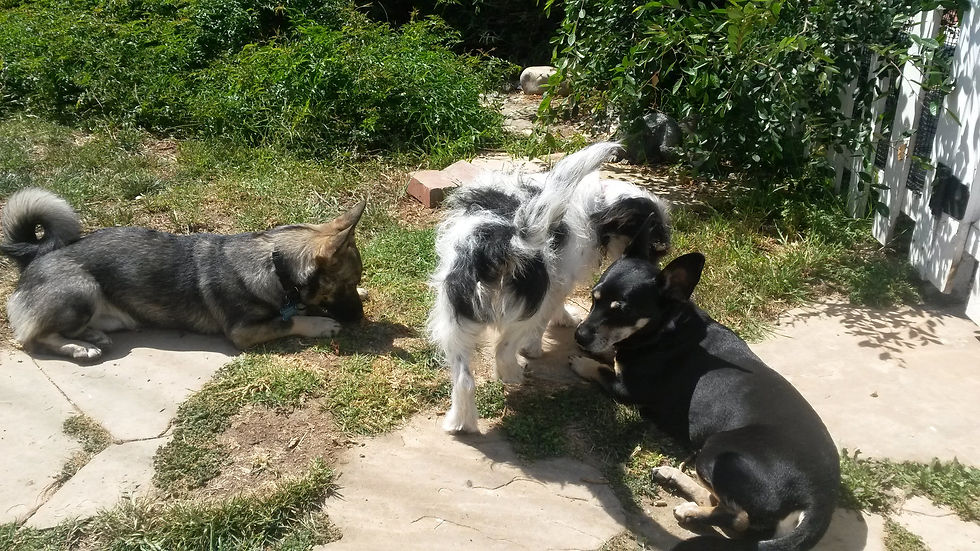
A Swedish Vallhund puppy lays calmly near a black & white terrier mix and a black & tan Dachshund mix in a backyard. The puppy is sunning himself on a stone, and the terrier mix is walking away from the camera between the puppy and the Dachshund mix, who is also lying in the sun. NOTE: It is typically easiest to meet a new dog after walking across the street from them for a block, then gradually moving closer over the course of another block. Avoid dogs who are over-exuberant (don’t know how to stop playing) or are too tolerant (will put up with continuous puppy shenanigans without ever giving a correction, or worse yet, will eventually give in to pestering and play). Being growled or snapped at (not bitten) when the puppy is being obnoxious is critical for them to learn proper social skills, but being over-corrected (pinned or bitten) will likely cause fear reactions towards dogs, so be sure you know the dogs you are allowing your puppy to meet.
Practice hanging out with other dogs without playing. You can start by hanging out at a friend’s house and working on relax-on-a-mat skills after play time, then work your way to practicing in public at park benches and cafes.
If you only practice one thing with your puppy, have it be SETTLE. If your pup can relax anywhere, they can learn anywhere. Obedience skills can be taught at any age, but relaxation skills and basic manners (no jumping/mouthing) become harder to teach as your pup gets older. People watching is a skill all dogs must master.
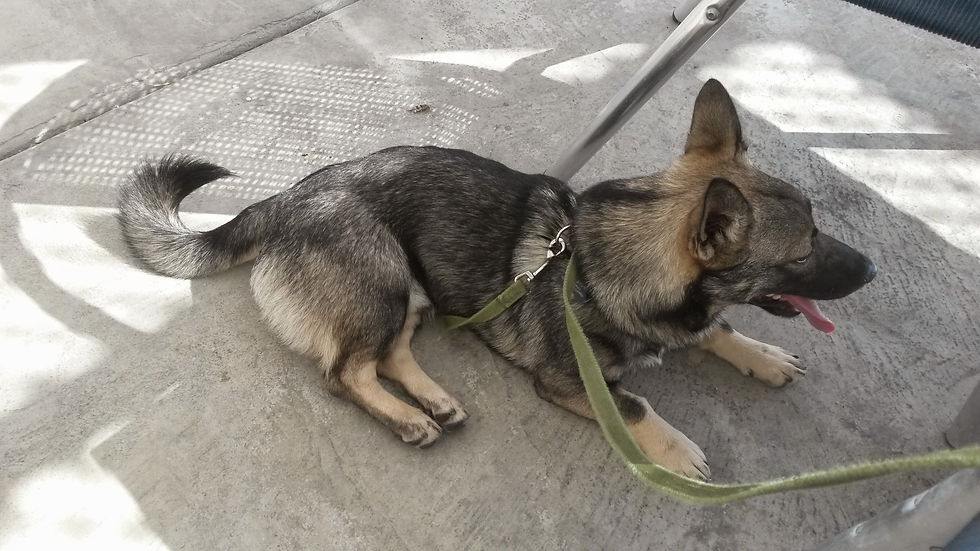
A Swedish Vallhund puppy with a green leash lays under a chair on a concrete patio. He is relaxed with his curly tail unfurled, laying on one hip, his eyes softly closed, and his mouth open with tongue hanging loose. Know that adolescent dogs will need to move their bodies more than younger puppies and adult dogs. If your pup is antsy, don’t force a settle exercise on them. Once your pup is 5-6 months old, focus more on attention games (WATCH ME), DROP IT games (fetch/tug) for cooperation, recall (COME when called), and free play with your dog (no toys, just silliness). These all strengthen your teamwork skills with less frustration than stationary (STAY/WAIT) activities. Do sprinkle in an occasional PLACE/STAY throughout training sessions and walks so that your pup doesn’t forget them entirely, but don’t make that the main focus of your training.
Make your training look like real life: Once your pup understands a concept, keep treats off of your body - cue the behavior, mark with a “YES!” (or clicker) when they perform the behavior, then grab a treat from your pre-placed container on a nearby table or shelf. Practice PLACE while you tidy a room, put away laundry, or make dinner. Have friends come over and practice calm greetings. Also be sure to place items for your dog to practice LEAVE IT on walks.
Start and maintain crate/gate training. Many puppies start off tolerating crates well, but as their potty training improves, they are given too much freedom, and then they rebel when crated again. Be sure to crate/gate your pup for at least 15 minutes a day, every day, and not just when you’re leaving. Meal times (yours and/or theirs) are a great time to practice crating since you’ll want to crate your pup during meals with kids so that they don’t eat fallen food (and thus encourage your child to throw food), but do be aware that most puppies and even some adults may need to go potty immediately after eating.

A Bichon mix lays comfortably in his crate while chewing on a slice of hairy pig ear. Due to the close camera angle, he is looking intently at the camera person, perhaps worried that the pig ear will be taken. Introduce (and maintain) gates/indoor fencing in your home where you may need to separate your pup from a crawling baby, a wobbly toddler, or a rambunctious child. Common places to place gates are between living and dining rooms, in kitchen doorways, and at the ends of hallways. Practice spending time on the opposite side of the fence as your dog, perhaps folding laundry in the living room while your dog enjoys a chew on their bed in the dining room, or cooking in the kitchen while your pup plays with toys in the living room. Gates are truly a necessity when living with dogs and kids until your youngest child is at least 5 years old, and they remain necessary even after that when your child wants to run wild and you need to keep the dog and child separate and safe from each other.
Allow your puppy to observe children from afar at first, and gradually introduce children one at a time in controlled environments (homes) as your puppy is able to settle. Keep your puppy on a short leash, and make sure the children are given explicit directions: wait for the puppy to sniff/lick you, then pet from collar to tail, or on the chest and shoulder. “One hand is enough, Two hands are too rough.” Kids 4-5 years and older may also toss a toy for your puppy, but you should be in charge of cueing DROP IT.
Hang out around a variety of people and practice SETTLE in the presence of babies and young children. It’s best practice to exercise your puppy first (you can even go on a walk with the baby/child in a stroller), keep him on a 4ft leash (giving the baby/child plenty of space), and bring a comfy place to lie down with a stuffed frozen Kong, a collagen chew, bully stick, or lickimat to help him relax. Ensure children aren’t approaching your pup during settle on the mat, and only allow one child (3 years or older) to approach at a time when giving your pup a break from the mat. Only allow petting if your puppy shows calm interest in the child first, and ensure their parent is holding their child's hand to guide petting ("One hand is enough, Two hands are too rough!"). Take a break if either the child(ren) or puppy becomes too excited, and always leave before your pup gets antsy.
Again, these tips are for ALL puppies and dogs, but especially for those pups who are going to be your "first child." It can be quite a shock for dogs who have always been the center of attention to have new rules and unpredictable routines suddenly forced upon them, so it's best to prepare from the very start. Family Paws Parent Educators like myself are especially prepared to help you set yourselves and your pup up for success when preparing for growing your family, so don't wait until you're already pregnant or have submitted an application for fostering/adoption to get started. "Don't take a chance... Prepare in advance!"
*Avoid homes/places frequented by dogs who go to do parks/beaches and dog daycares until your pup is fully vaccinated (approx. 14-16 weeks of age), as they may bring the germs with them. Giardia (a parasitic infection spread by feces, which can cause severe dehydration) and Parvo (a virus spread by vomit & feces with 50% mortality rate) can both live for 6+ months in soil, grass, or other surfaces in southern California’s moderate climate. Distemper (a virus spread by saliva, respiratory droplets, urine, and feces with a very high mortality rate) is more common in wild animals (coyotes, foxes, skunks, raccoons, etc), but only survives for a few hours in the environment at room temperature (but up to a few weeks in cold & damp), so it is much less common. Kennel cough is a respiratory virus and is spread easily through coughing, barking, and shared water dishes. The viruses and/or bacteria that cause it can live for about a week on surfaces, and the virus can be shed from infected dogs for weeks to months. **Again, be aware of whether the dog frequents dog parks or dog daycares as they are more likely to carry diseases. Only playing with other puppies will not teach them the same manners as being ignored and/or gently & appropriately corrected by an adult dog. Do not allow your puppy to pester another dog to play - if the other dog turns away, yawns, shakes off, or otherwise tries to ignore your pup, gently remove your pup and practice settle at a further distance instead. Some dogs are too tolerant and teach your puppy to be rude to request play, which can lead to miscommunication and fights later on. However, some rambunctious play with other young dogs (with plenty of breaks!) can be great for building confidence.


Comments